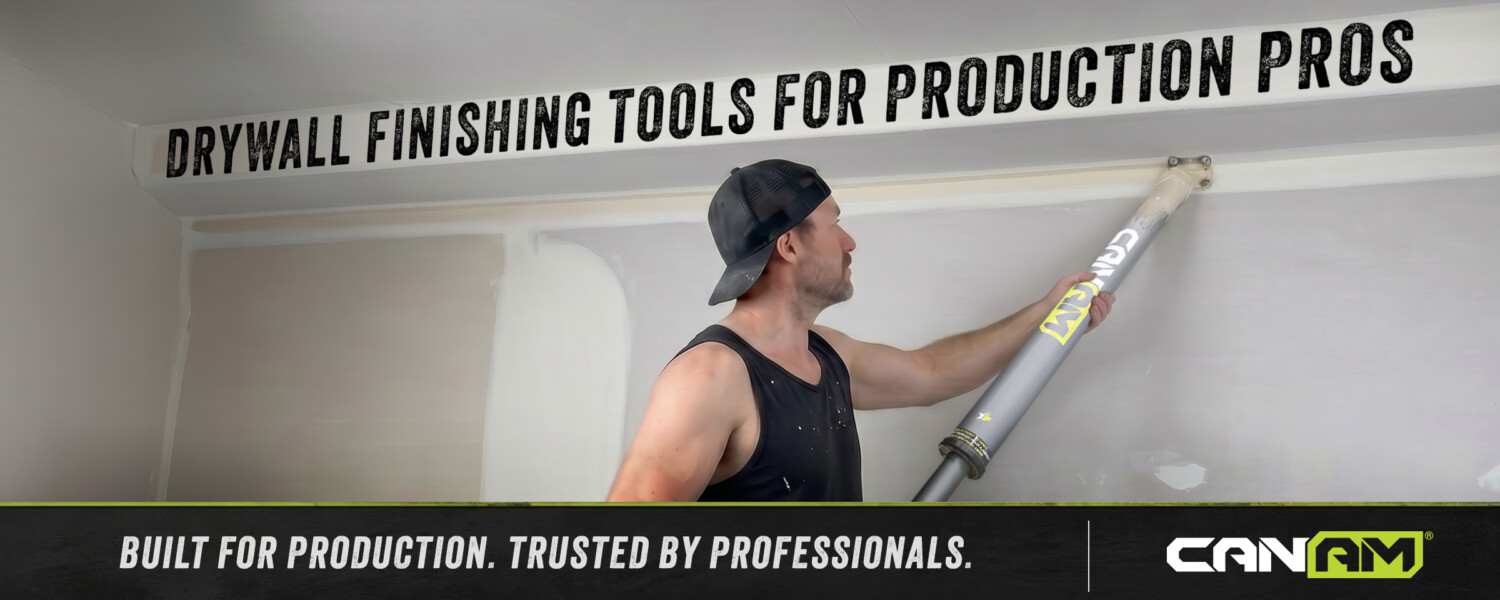
Production drywall finishing is a different job from a weekend patch. You’re paid by the job more often than by the hour, working to schedules that don’t flex, and the line between a good year and a hard one comes down to one thing: how fast you finish clean. That changes how you think about tools. Here’s what separates production-grade finishing from weekend work — and what the pros actually run.
Finishing is a productivity game
Every coat of mud is dry time. Every pass with a knife is a pass you have to sand. Every corner done one side at a time is double the work. Hand taping piles all of that up — three to four coats per joint, a sanding marathon at the end, and a body that feels every job.
Production finishers don’t beat that by working faster with the same tools. They beat it by changing the tools. Lay the mud right the first time instead of building it up over three coats, finish both sides of a corner in a single pass, run everything standing up instead of climbing — and a job that took two days takes one. Whether it’s a single house, a multi-unit build, or a commercial fit-out, that saved time compounds across a season into real money.
That’s the math that drives every serious finisher toward a system.
What the pros run
A production finishing setup is a system, not a single tool. (See how to choose your first setup →) The pieces work together:
- A compound tube — the hand-pump that holds your mud and meters it out, fast, with no machine to maintain. One fill runs a whole small room.
- Applicators — flat heads for seams, inside and outside corner heads for angles, all fed off the tube.
- Rollers — to embed tape and bead so nothing blisters later.
- Corner finishers — wiping and feathering both sides of an angle into a sand-ready corner in one pass.
- Handles — flusher and extendable, so ceilings and full-height corners get done without a ladder.
Put together, it’s the semi-automatic system that turns the slowest, most punishing parts of the job into fast, repeatable passes. Most finishers start with a kit and build from there.
Prefer to watch? See the full production setup in action:
Built by the company that started it
There’s a reason this system shows up on production sites everywhere: CanAm invented it. CanAm is the company that created the semi-automatic finishing category — building and backing these tools out of Alberta since 1973.
For a finisher, that heritage means a few practical things:
- Decades of design built into the tools by people who’ve spent fifty years figuring out what actually speeds up a finish.
- Parts and service across North America — when a tool needs a part mid-season, you’re not stranded waiting on it.
- A lifetime performance policy — any defect in materials or workmanship gets repaired or replaced, with no expiry date and no fine print that quietly voids it. The same commitment that’s been on every tool since 1973.
- A reach that’s gone global — CanAm tools run on job sites across North America and are exported worldwide, from Australia to beyond.
When the tools are designed and backed by the people who started the whole category, the system just runs smoother.
What compounds over the years
The first job is where you notice the speed. The real payoff shows up over seasons:
- More jobs per year because each one moves faster.
- Less wear on your body, which is what keeps finishers working into their fifties and sixties instead of burning out.
- Tools that last — durable bodies, replaceable parts, no machine to babysit — so the investment keeps paying instead of needing replacing.
Productivity isn’t a one-job win. It’s the thing that quietly decides how good a year you have, every year.
The takeaway
Production finishing means finishing fast and clean, job after job, season after season — houses, multi-unit, and commercial alike — and the pros who do it aren’t fighting through it by hand. They run a semi-automatic system that lays mud right the first time and finishes corners in a single pass. CanAm has built that system since 1973 and put it on job sites around the world.
Get the complete system production pros run. Built for production. See the Professional Tool Kit →