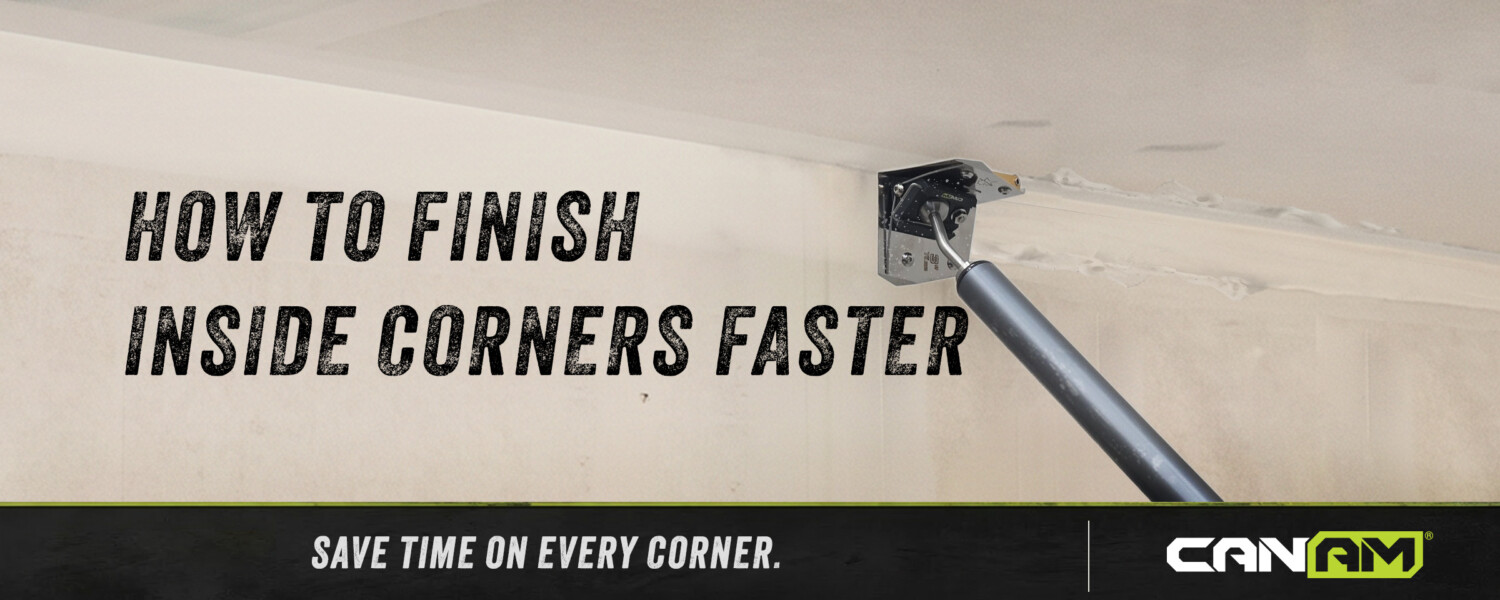
Inside corners are where taping jobs slow to a crawl. Flats and butts you can move through. But a corner has two sides meeting at an angle, and the second you load mud on one wall you’re fighting not to wreck the other. Finish corners the slow way and they’ll eat your whole day. Finish them right and they’re the fastest part of the wall. Here’s the difference.
Why corners are slow by hand
Run an inside corner with a knife and you’re finishing two surfaces that won’t leave each other alone:
- You mud one side, set tape, and try to flush it — but your knife keeps dragging mud onto the side you haven’t done yet.
- So a lot of finishers do one side, wait for it to dry, then do the other — doubling the dry time on every angle in the building.
- Then it’s the usual three-coat grind on top of that: tape coat, fill, finish, each one sanded and recoated.
Multiply that by every corner in a house and the math gets ugly fast. The corner isn’t hard. The hand method just makes it slow.
The faster way: one pass, both sides
The whole reason CanAm built the semi-automatic corner system — the category it invented back in 1973 — was to finish both sides of an angle in a single motion instead of babysitting them one at a time. Here’s the full semi-automatic tool flow, start to finish →
The sequence is four quick steps:
1. Mud the corner. A compound tube feeds the corner applicator, which lays an even charge of mud down both sides of the angle at once — no pan, no reloading, no starved spots.
2. Run your tape. Press paper tape into the wet mud straight down the angle.
3. Roll it. A corner roller seats the tape into both walls at the same time and squeezes out the excess.
4. Flush it. A corner flusher wipes both sides in one stroke, feathering the mud and leaving a finished angle behind it.
That’s it. Both sides, embedded and finished, in one continuous pass — not two halves with a dry-time gap in the middle. Put it on an extendable handle and you’re running floor-to-ceiling angles and wall-to-ceiling lines without ever touching a ladder.
Prefer to watch? Here’s the faster way in action:
How many coats does an inside corner actually need?
By hand or with tools, an inside corner takes the same three coats: a tape coat, a fill coat, and a finish coat. The difference isn’t the coat count — it’s that the system finishes both sides at once, every pass, instead of one wall at a time with a dry-time wait in between.
That’s where the time goes. By hand, you mud one side, wait for it to dry so you don’t wreck it, then come back for the other — before you’ve even started your fill and finish coats. The system kills that mid-corner wait on every angle in the building. Same three coats, roughly half the time.
The mistakes that slow you down
Even with the right tools, three habits cost finishers time on corners:
- Overloading the mud. More compound doesn’t mean a better corner — it means more to flush off and more to sand. Let the tube meter it.
- Skipping the roll. If the tape isn’t fully seated, it’ll bubble or blister and you’re back cutting it out. The roller is not the step to rush.
- Chasing a finish coat the corner doesn’t need. If the flush left it clean, prime it. The extra skim is preference, not a requirement.
The takeaway
Finishing inside drywall corners faster isn’t about moving your hands quicker — it’s about finishing both sides at once instead of one wall at a time. Mud, tape, roll, flush — both sides in a single pass, then your fill and finish coats as each dries, with none of the one-side-at-a-time waiting that eats a hand-taped angle. Same coats, far less time. That’s how a corner goes from the slowest part of the wall to the fastest.
CanAm builds the corner finishing system that makes it happen. Built for production. See the inside corner finishers →