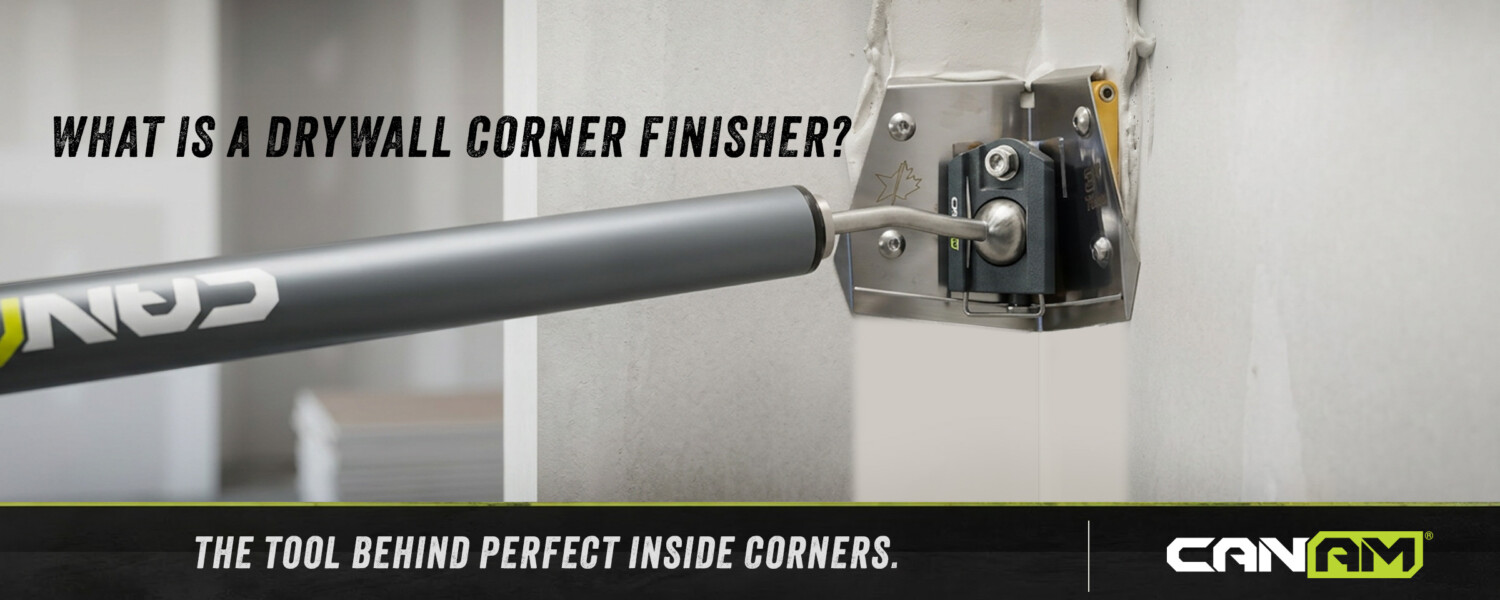
If you’ve watched a production crew tape an inside corner and wondered what that angled metal tool gliding down the seam was, that’s a corner finisher — sometimes called a flusher or an angle head. It’s the tool that turns the slowest part of taping into one clean pass. Here’s what it is, what it does, and how to run one.
What a corner finisher is
A drywall corner finisher is a tool built to wipe, feather, and finish both sides of an inside 90° angle at the same time, in a single pass. Instead of running a knife down one wall, then the other, then going back to clean up where they meet, the finisher does both walls in one motion and leaves a feathered, near-finished corner behind it.
The working end — the flusher head — is a single piece of aerospace-grade stainless steel, bent and ground to the optimal shape, with feathering tabs that feather the mud out at the edges so it blends into the board. It rides on runners that glide right over dry material, screws, and nail heads without digging in. The flusher head has a universal ball joint that connects to a flusher handle, extending your reach so you’re running corners standing up — including ceiling lines and full-height angles — instead of crouching with a knife.
What it does in the finishing process
The corner finisher is the last step in the inside-corner sequence, not the first. When you’re taping an angle, the full flow looks like this:
1. Apply mud to the angle (with a corner applicator fed by a compound tube, or by hand).
2. Set the tape into the wet mud down the corner.
3. Roll it with a corner roller to embed the tape and squeeze out the excess.
4. Flush it — this is where the corner finisher comes in, wiping both sides clean and feathering the mud out flat.
That last pass is what gives you the smooth, sand-ready angle. A good finisher leaves so little behind that sanding is a quick scuff instead of a chore.
How to use one
Running a corner finisher is simple once the mud and tape are in:
- Mount it on a flusher handle sized to the wall you’re working — short for low angles, extendable for full height.
- Pick your size. Finishers run from 2.5″ up to 4.0″. A smaller head lays a tighter first finish; a wider head feathers the mud out farther for a final coat. Many finishers run a smaller size on the first pass and a larger one on the second.
- Set it in the angle and pull it along the corner in one steady motion. The flusher head wipes both walls, the feathering tabs feather the edges, and the runners glide over anything dried on the surface while acting as a mud dam — stopping excess mud from spilling past the feathering tabs.
- Keep the pressure even. Let the tool do the work — leaning on it hard doesn’t make a better corner, it just scrapes mud you’ll have to replace.
That’s the whole move — one pass, both sides done.
Prefer to watch? See a corner finisher run an angle:
The different types
CanAm builds a few versions depending on how you like to work:
- Standard Corner Finishers — the classic wiping finisher. You apply mud first, then run the finisher to wipe and feather. Lightweight aluminum hub, stainless body, mounts on any flusher handle.
- Roller Glide Corner Finishers — CanAm’s best-selling flusher, with patented Roller Glide runners that reduce friction and glide over screws and wet tape without chatter or catching. The workhorse of the Professional Tool Kit, and the one most production crews reach for.
- Direct and Variable Flow finishers — mud-fed versions that flow compound through the tool straight from your compound tube, so you apply and finish in one pass. The Variable Flow model adds an adjustable cover plate to dial the mud flow up or down.
- Accu-Just Corner Finishers — the premium adjustable line that adjusts the flusher to fit a wide range of corner angles, from 72 to 135 degrees.
For most crews getting into semi-automatic tools, a Standard finisher and a flusher handle is the entry point that pays for itself fast.
Why it matters on a production job
Inside corners are where hand taping bleeds time — two surfaces, multiple coats, constant cleanup where the walls meet. A corner finisher collapses that into one pass that comes off clean enough to barely sand. Multiply that across every angle in a building and it’s the difference between knocking out a whole house’s angles in half a day and grinding through them by hand in a day or more.
That’s the whole idea behind the semi-automatic system CanAm invented back in 1973: lay it right, finish it once, move on.
The takeaway
A drywall corner finisher wipes and feathers both sides of an inside angle in a single pass, leaving a clean, sand-ready corner. Apply mud, set and roll the tape, then run the finisher along the angle on a handle — that’s it. It’s the tool that takes the slowest part of the wall and makes it the fastest.
CanAm builds corner finishers for every coat and every crew. Built for production. See the Standard Corner Finishers →