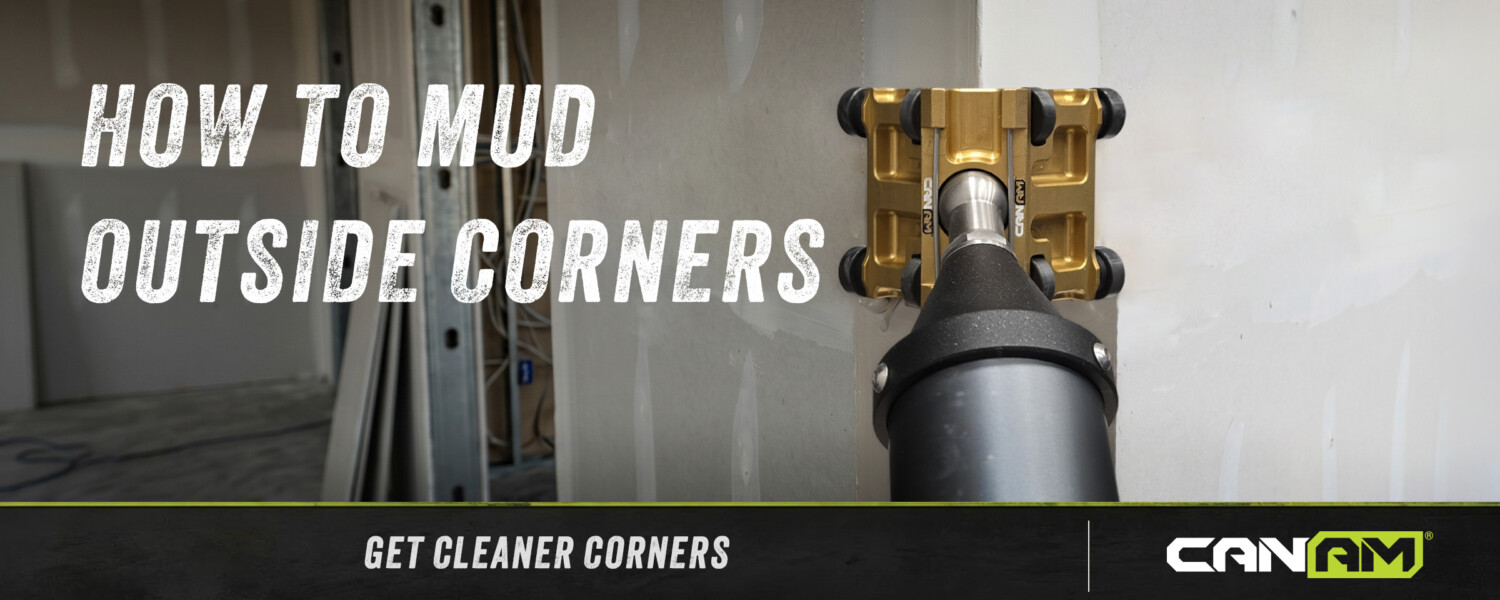
Outside corners are the opposite problem from inside ones. Instead of two sides meeting in a valley and fighting each other, you’ve got a raised edge sticking out into the room — the most exposed, most-likely-to-get-hit spot on the whole wall. Mud it wrong and it shows under every light and chips the first time something bumps it. Get the corner bead set clean, and the rest is just feathering mud off it.
First, what’s a corner bead?
A corner bead is the strip you set on a raw outside corner to give it a dead-straight line and reinforce that exposed edge so it doesn’t chip. You mud it in and feather over it to hide it. No bead, no clean outside corner — so the bead is where every outside corner lives or dies.
Choosing the right bead
The bead sets your line — if it’s straight and solid, a good corner is almost automatic. If it’s wavy or loose, no amount of mud saves it. A few common types:
- Paper-faced bead — set into a coat of compound and rolled to seat it, so it goes on as part of your mud flow. This is the one that runs with semi-automatic tools.
- Metal bead — the traditional choice, nailed or screwed on before you mud. Tough, but it has to go on dead straight.
- Vinyl / bullnose bead — durable and dent-resistant, also set in compound, and gives you a rounded corner instead of a sharp 90.
Once the bead is in, CanAm’s Bead Rollers seat it cleanly — pressing the corner bead exactly where it needs to go (in square or bullnose styles to match your bead).
The flow: compound, bead, roll, knife
With paper-faced bead and semi-automatic tools, an outside corner runs in one clean sequence — and the compound goes on first, not last:
1. Lay the compound. A compound tube feeds the GoldCor Outside Corner Applicator, which lays an even coat of compound over the corner in one motion. It rides on eight wheels — more contact to keep the tool centered and tracking the bisection of the corner — runs two ways, and comes set up for the bead profile you’re running: square bead, bullnose, or center fill.
2. Set the bead. Press the corner bead into the wet compound, straight down the corner.
3. Roll it. A bead roller seats the bead into the compound and squeezes out the excess so it sits tight and true.
4. Knife it. Run a knife or trowel down each side, feathering the compound off the nose and out to the wall.
(Running rigid metal bead instead? That one gets fastened on first, then you coat over it — but the paper-faced, mud-first flow is what keeps an outside corner moving at production speed.)
Prefer to watch? See an outside corner run start to finish:
Feather off the nose, not onto it
However the bead goes on, finishing it is about working from the bead’s high point — the nose — out to the wall, feathering each side so the eye never catches the transition. The mistake that costs people here is overfilling — burying the nose so the corner loses its crisp line, then sanding half of it back off. Feather thin and wide instead.
How many coats?
After the bead is set, plan on two finish coats — a fill pass and a feathered finish pass, each one feathered wider than the last. Some finishers run a third for a glass-flat result under hard light. The bead sets your line and your high point, so each coat is just dressing compound off the nose and out to the wall, not building the corner from scratch.
The mistakes that show up later
- Bead not set straight or solid — the corner is only as good as the bead under it. Get this right first.
- Overfilling the nose — more mud doesn’t protect the corner, it just buries the line and adds sanding. Feather thin and wide.
- Stopping the feather too soon — a short feather leaves a ridge that catches every light in the room. Carry it well out onto the wall.
The takeaway
Mudding a drywall outside corner comes down to a straight bead and mud feathered off the nose instead of piled onto it. With paper-faced bead and the outside corner applicator, the flow is one clean sequence: lay the compound, set the bead, roll it, and knife each side — then two finish coats and an outside corner comes out sharp instead of holding you up.
CanAm builds the corner finishing system for both sides of every angle. Built for production. See the GoldCor Outside Corner Applicator →