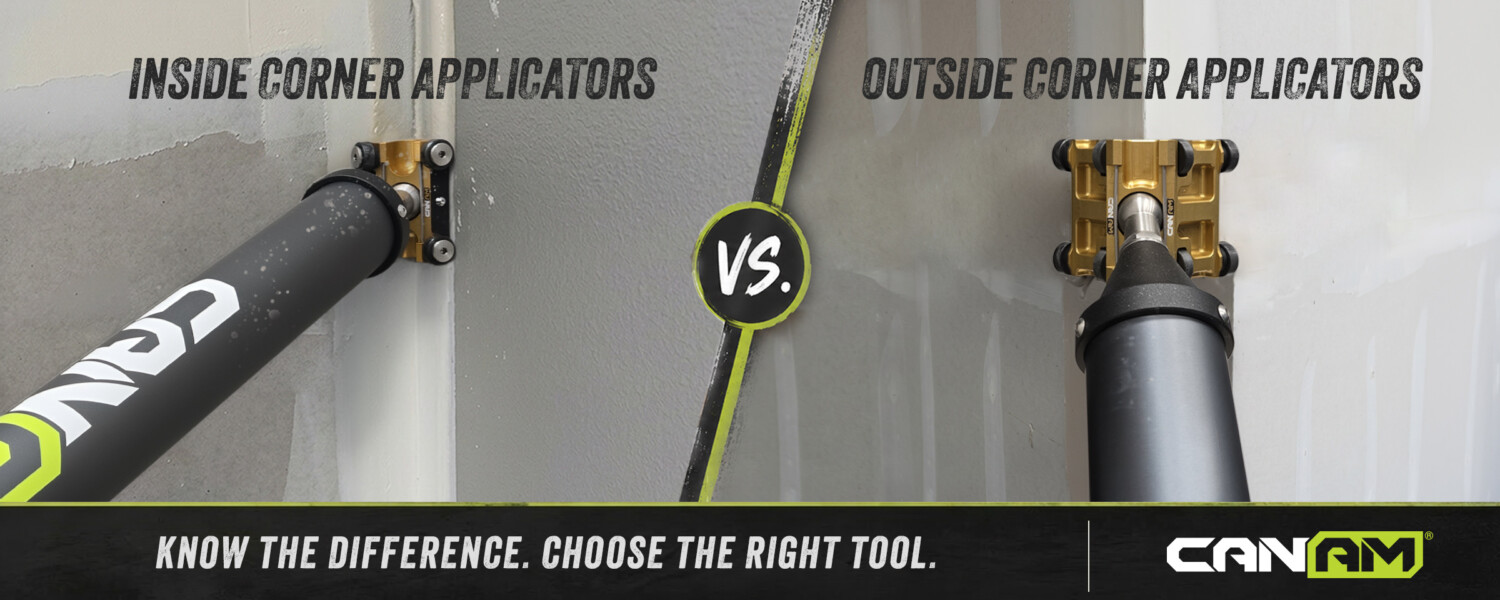
If you’re shopping for a corner mud applicator and seeing “inside” and “outside” versions, here’s the short answer: they’re two different tools for two opposite jobs, and you can’t swap one for the other. An inside applicator works a concave angle; an outside applicator works a convex one. Most finishers end up needing both — but if you’re picking where to start, this breaks down which is which and which to buy first.
The difference is the geometry
Every corner in a building is one of two shapes:
- An inside corner is the valley where two walls turn into the room — the concave angle you see in every room’s vertical corners and where walls meet the ceiling.
- An outside corner is the edge that sticks out into the room — the convex angle on door and window returns, soffits, columns, and bulkheads, almost always built over a corner bead.
The mud has to go on completely differently for each, which is why the tools are built differently.
The inside corner applicator
An inside corner applicator lays mud down both sides of a concave angle at once. CanAm’s GoldCor Inside Corner Applicator rides on four wheels, runs two ways (back and forth without turning the tool around), and uses spring-loaded flow control to lay a clean, even coat without the mess.
There’s also a budget option: the 2-Wheel Inside Corner Applicator at $95, a simpler entry point that does the same basic job. Either one feeds off your compound tube and applies the mud you then tape, roll, and finish. (See the full inside-corner flow →).
The outside corner applicator
An outside corner applicator does the opposite — it works a raised, convex corner instead of filling a valley. CanAm’s GoldCor Outside Corner Applicator rides on eight wheels — more contact to keep the tool centered and tracking the bisection of the corner — runs two ways like the inside version, and comes set up for the bead profile you’re running: square bead, bullnose, or center fill. It lays an even coat of compound over the corner in one motion; then you place the corner bead, roll it, and knife each side to finish. (See the full outside-corner flow →).
Because it’s tracking a protruding edge instead of settling into a valley, the outside applicator is a genuinely different head — not an inside tool turned around.
So which do you need?
It depends on the work, but here’s how most finishers think about it:
- You’ll eventually want both. Almost every job has inside and outside corners, so a complete kit covers both. They’re not either/or in the long run.
- Start with the inside applicator if you’re buying one first. Inside corners massively outnumber outside corners on a typical build — every room is full of them — so the inside tool earns its keep fastest.
- Add the outside applicator when you’re regularly running beaded corners — lots of door and window returns, soffits, or commercial work with columns and bulkheads.
The good news on cost: both heads run off the same compound tube. Once you own the tube, adding the second applicator is an inexpensive step, not a whole new setup.
They’re part of one flow
Whichever applicator you’re using, it’s the mud-laying step in the same sequence:
1. Applicator lays the mud — inside the angle, or on the outside corner.
2. Tape or corner bead goes on, and a corner roller embeds either one.
3. The corner gets finished — a corner finisher for inside angles, a knife or trowel for outside.
The applicator’s whole job is to put a clean, metered coat exactly where it belongs so the rest of the pass goes fast. That’s the difference between filling corners and finishing them.
Prefer to watch? See both applicators in action:
The takeaway
Inside and outside corner mud applicators aren’t interchangeable — one fills a valley, the other coats a protruding corner. Most finishers need both eventually, but the inside applicator is usually the smarter first buy since inside corners are everywhere. Either way, both feed off the same compound tube, so building out your corner setup is cheap once the tube’s in your hand.
CanAm builds applicators for both sides of every angle. Built for production. Compare the inside and outside corner applicators →